650 nm
Surface
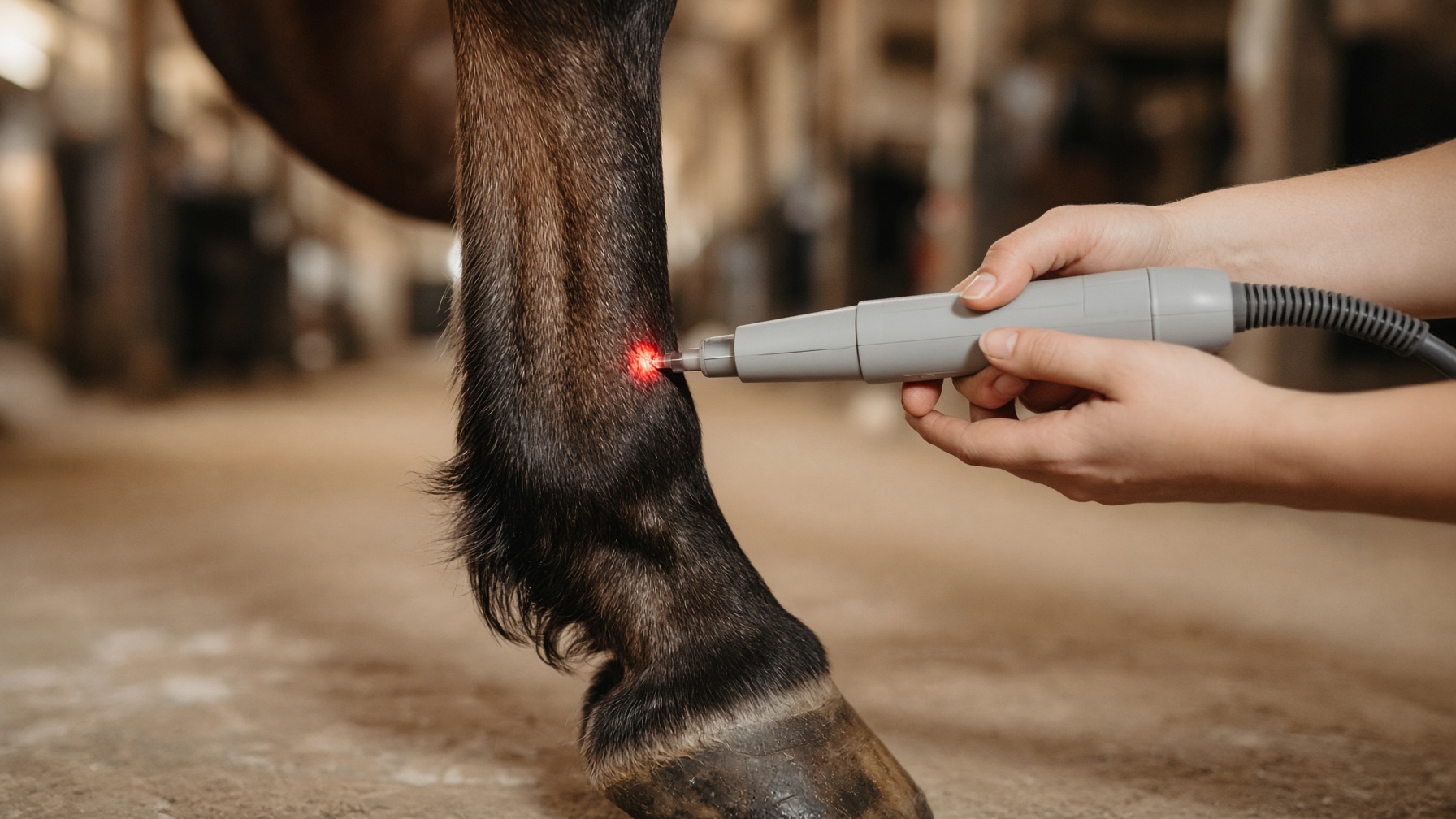
Skin, shallow tissue, and the aiming beam. Useful on a wound edge or a spot you need to see exactly. It does not reach a suspensory.

Kemp Equine
The same KDT Neural Flex I use on people — 650, 810, 980, and 1064 nm — on the structures a horse actually loads.
A horse is not a bigger person. The target is deeper, the coat gets in the way, and a 10-watt barn laser often never arrives. This unit is 30 watts each at 810, 980, and 1064 — 90 watts peak, 60 watts continuous — plus 650 nm red light. Sessions are short. The horse feels warmth, not a shock.
I use it with the adjustment, not instead of it. Motion first. Light on the tissue that has been compensating.
The wavelengths
650 nm
Skin, shallow tissue, and the aiming beam. Useful on a wound edge or a spot you need to see exactly. It does not reach a suspensory.
810 nm
The wavelength for tissue with a blood supply. Back muscle, shoulder, glute — the soreness that shows up after work and after the spine starts moving again.
980 nm
Absorbed more by water. Strong on pain in denser tissue. The one I use when the horse is guarding a joint or a tendon and will not let you near it.
1064 nm · the extra on a horse
The one that matters on a horse. Coat, pigment, and muscle mass eat the shorter wavelengths. 1064 scatters less, so it reaches a suspensory, a deep glute, or a joint under a lot of tissue. Most barn lasers still stop at 810 and 980.
Where I use it
Superficial digital flexor, deep digital flexor, and the suspensory. The structures that take the load. Laser does not replace rest or a veterinary plan. It is for the tissue once we know what we are treating.
Sore epaxial muscle along the spine, after the adjustment. A back that will not lift usually has both a joint that is not moving and muscle that has been doing the job for it.
Soft-tissue soreness around the joints that do the work — not a diagnosis of the joint itself. If the horse is lame, the veterinarian leads. I treat what is sore around it.
Tight muscle that changes the stride: poll and neck after a headset fight, shoulder after a trailer haul, hamstring and glute on a horse that is not tracking up.
This is not a lameness workup and it is not a promise to fix a tendon. If the horse is off, your veterinarian should see it. Laser is for the tissue we already understand — alongside hands-on chiropractic.
Request an equine visitBy appointment Tuesday, Friday, and Saturday. Text is the fastest way to reach me.